

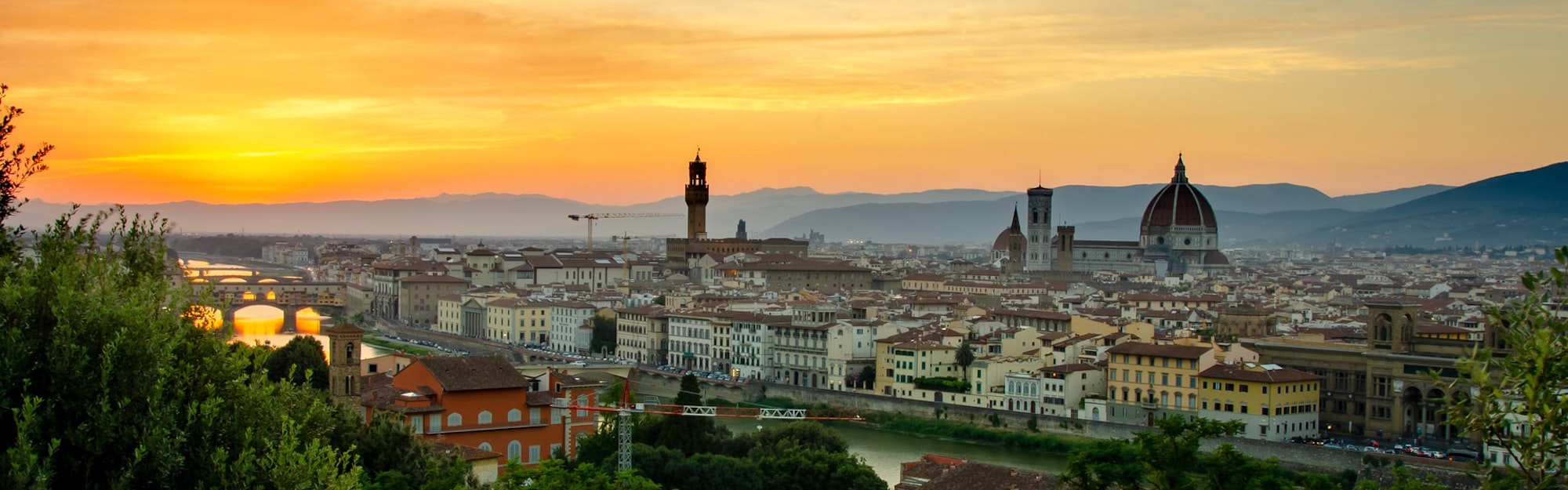

Florence Travel Guide
Seemingly eternal in its allure, Florence is one of the most beautiful cities in the world and a treasure trove of Renaissance art and culture. Despite being over-run with tourists for centuries, people continue to flock to holiday in this sumptuous destination of artistic, architectural and cultural gems. In a relatively small area, Florence contains a wealth of Renaissance art treasures on streets that were once walked by great artists such as Michelangelo, Boticelli and Leonardo da Vinci. The entire historic old town of Florence is a UNESCO World Heritage Site. The city is also known for its good shopping and great Tuscan cuisine. Florence is the launching pad for the stunning countryside, wine routes, Etruscan sites and medieval hill villages of Tuscany, one of the most popular tourist region's in Italy.
No self-respecting European tourist can miss out on a holiday in Florence, which ranks as one of the must-see Italian cities. Serious art-lovers, who are out to do more than just tick the destination boxes, also place a holiday in Florence at the very top of their itineraries.
Best time to visit Florence
High season for a holiday in Florence is high summer (June to August), when the sun bakes down from the blue Tuscan skies. Crowds make this season unpleasant for serious art-lovers. For a relatively quieter view, it's best to travel here in spring or autumn (April, May, September, October), or even during the mild winter, although during this season visitors should anticipate rainy days.
What to see in Florence
-View an unrivalled panorama of the city from the cupola of the Cathedral of Florence.
-See the tombs of Michelangelo and Galileo in the beautiful Gothic church of Santa Croce.
-Marvel at the Renaissance sculpture collection in The Bargello, Italy's first national museum.
-Admire the art in The Uffizi, one of the world's greatest art galleries.
What to do in Florence
-Explore the many museums and landscaped gardens of Palazzo Pitti, the Medici family headquarters.
-Visit the world-famous Florence Accademia to see Michelangelo's statue of David.
-Wander by the quaint shops on Ponte Vecchio, the oldest bridge in Florence.
-Tour the Basilica di San Miniato al Monte, a superb example of Tuscan Romanesque architecture.
Beyond Florence
There are many fun and popular excursions from Florence into the surrounding Tuscan countryside and to nearby villages and cities. The scenic coastal stretch of Cinque Terre draws many visitors. The Chianti Wine Region could keep tourists occupied for days. Famously charming Tuscan towns, like Siena and San Gimignano, are perfect for day-trippers from Florence. Pisa, with its famous Leaning Tower, is also close by.
Getting there
Flights to Florence land at Florence City Airport and at Pisa Airport, 50 miles (80km) west of Florence. Many visitors also land at the Bologna G Marconi Airport which is conveniently close to a number of cities, including Florence.
Did you know?
-The Via Chiantigiana, between Florence and Siena, is often called the most beautiful road in Italy.
-Florence Nightingale was named for the city where she was born.
-Florence became the first European city with paved streets in 1339.