

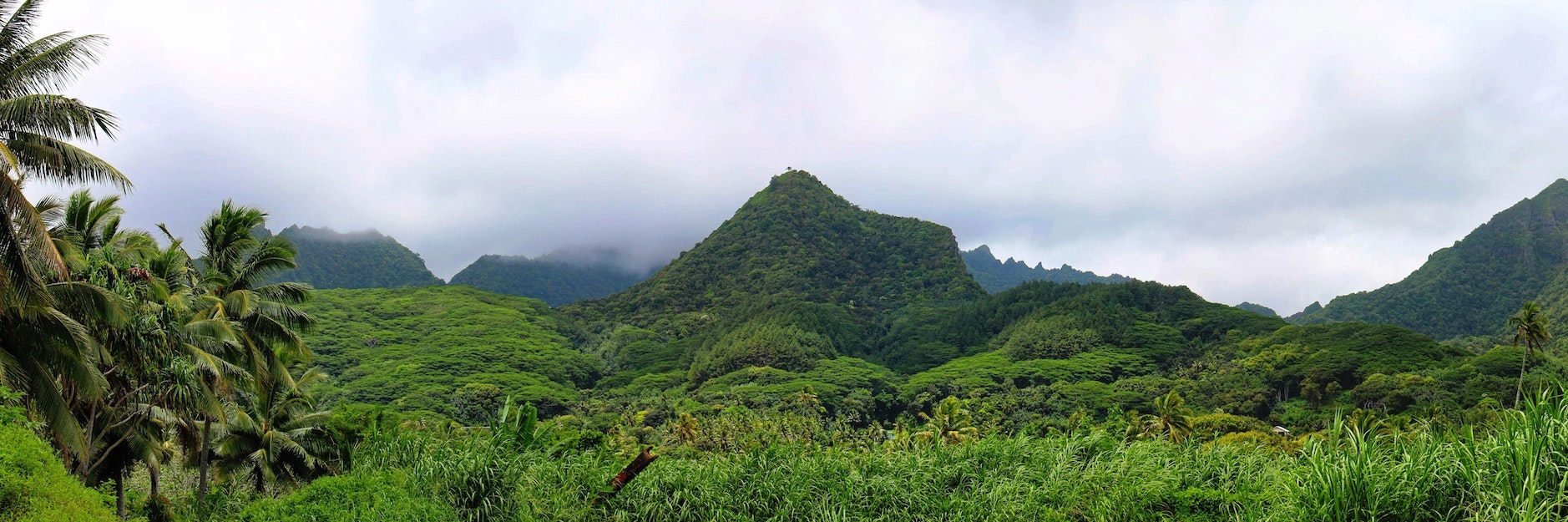
Country guides
 Australasia
Electricity
Electrical current is 240 volts, 50Hz. The three-pin flat blade plug with two slanted pins are used.
Language
Cook Island Maori is widely spoken by locals, but English is in common use.
Money
The currency is either the Cook Islands Dollar, which is divided into 100 cents, or the New Zealand Dollar (NZD), which is also divided into 100 cents, and the two are of equal value. Foreign currency exchange is available at the airport and ATMs are limited outside Rarotonga and Aitutaki. Credit and some debit cards are widely accepted on the capital island and some places on Aitutaki. Travellers should expect to need cash on the other islands.
Tipping
Tipping is not expected and is contrary to Cook Islands custom.
Health
There is little risk of disease on the Cook Islands, but visitors should take precautions against insect bites and sunburn. Outbreaks of dengue fever can occur so a good arsenal of mosquito repellent and protective clothing is advised.
Although no vaccinations are required, one or two may be recommended by a doctor as a precaution: vaccinations for hepatitis A and hepatitis B are sometimes recommended while a typhoid vaccination may also be required.
Locals consider the tap water safe, but boiled or bottled water is advised for visitors, particularly in rural areas. A range of medical and dental services are available on Rarotonga, including a hospital and various pharmacies, but medical facilities in the Cook Islands in general are limited and comprehensive travel insurance is advised to include air evacuation for emergencies.
If travellers require medication during their stay in the Cook Islands, it is best to take it with them. Travellers should make sure they have the necessary documents from their doctor to get the medication through customs.
Safety
Visits to the Cook Islands are usually trouble free. There is relatively little crime, but it is always advisable to protect valuables.
Local customs
Cook Islanders are known to be hospitable, generous and somewhat reserved, and will greet travellers who depart or return from voyages by placing a garland of flowers around their necks. Locals are also very religious and frown upon inappropriate dress. Beachwear should not be worn in town, and topless sunbathing is not acceptable behaviour.
Doing business
The main business centre is Avarua on Rarotonga Island. The business environment in the Cook Islands is fairly casual and relaxed. However, punctuality is important and dress should be modest, particularly for women. Meetings will be conducted in English when foreigners are present, although islanders may speak to one another in Maori to clarify their understanding during proceedings. It is not meant as an offence. Meetings usually begin and end with a prayer. Business hours are generally 8.30am to 4.30pm, Monday to Friday.
Duty free
Travellers over 18 years to the Cook Islands may import 2 litres of alcoholic beverage or 4.5 litres of beer, and 200 cigarettes or 20 cigars or 250g of tobacco. No firearms, cartridges or cartridge cases, gunpowder, bullets, and other forms of ammunition are allowed without prior permission from the Minister of Police.
Communications
The country code for the Cook Islands is +682. Resorts that offer free WiFi are located throughout the islands of Rarotonga and Aitutaki; visitors can purchase local SIM cards for unlocked phones.
Passport & Visa
Travellers are required to produce proof of onward passage, and adequate financial means to support their stay on entry into the Cook Islands. Those who plan on joining a tourist boat, yacht or other sea-going vessel to travel beyond the Cook Islands must apply for permission to enter via the Ministry of Foreign Affairs and Immigration. It's recommended that passports be valid for six months beyond the intended period of travel. Visa extensions are possible.
Entry requirements
US nationals must have a passport valid for six months beyond period of intended stay. A visa is not required for a stay of up to 31 days. Passengers who want to stay over 31 days can obtain an Entry Permit on arrival.
UK nationals must have a passport valid for six months beyond period of intended stay. A visa is not required for a stay of up to 31 days. Passengers who want to stay over 31 days can obtain an Entry Permit on arrival.
Canadian nationals must have a passport valid for six months beyond period of intended stay. A visa is not required for a stay of up to 31 days. Passengers who want to stay over 31 days can obtain an Entry Permit on arrival.
Australian nationals must have a passport valid for seven days beyond period of intended stay. A visa is not required for a stay of up to 31 days. Passengers who want to stay over 31 days can obtain an Entry Permit on arrival.
South African nationals must have a passport valid for six months beyond period of intended stay. A visa is not required for a stay of up to 31 days. Passengers who want to stay over 31 days can obtain an Entry Permit on arrival.
Irish nationals must have a passport valid for six months beyond period of intended stay. A visa is not required for a stay of up to 31 days. Passengers who want to stay over 31 days can obtain an Entry Permit on arrival.
New Zealand nationals must have a passport valid for seven days beyond period of intended stay. A visa is not required for a stay of up to 90 days.
Useful contacts
Cook Islands Tourism Corporation, Rarotonga: +682 29 435 or www.cookislands.travel
Police: 22 499. Emergencies: 999. Fire and rescue: 996.Embassies / consulates in other countries
Cook Islands Honorary Consul, Los Angeles, United States: +1 213 974 1307
New Zealand High Commission, London, United Kingdom (also responsible for Cook Islands): +44 20 7930 8422
New Zealand High Commission, Ottawa, Canada (also responsible for Cook Islands): +1 613 238 5991
Cook Islands Consulate, Sydney, Australia: +61 2 9907 6567
Cook Islands High Commission, Wellington, New Zealand: +64 (0)4 472 5126
Embassies / consulates in Cook Islands
United States Embassy, Wellington, New Zealand (also responsible for Cook Islands): +64 (0)4 462 6000
British High Commission, Wellington, New Zealand (also responsible for Cook Islands): +64 (0)4 924 2888
Canadian High Commission, Wellington, New Zealand (also responsible for Cook Islands): +64 (0)4 473 9577
Australian High Commission, Wellington, New Zealand (also responsible for Cook Islands): +64 (0)4 473 6411
South African High Commission, Canberra, Australia (also responsible for Cook Islands): +61 (0)2 6272 7300
New Zealand High Commission, Rarotonga: +682 22 201